If your marketing looks busy but revenue is not moving, something is off.
At Risely, we audit hundreds of marketing accounts every year across local and national markets. And the same hidden problems keep showing up. Not the obvious stuff like “post more” or “track your ads,” but deeper habits that quietly drain budget, stall growth, and skew performance data.
As we move into 2026, these mistakes are no longer harmless. They are expensive.
Below are three outdated marketing habits businesses need to leave behind and what to do instead if you want real, measurable growth.
1. Treating Your Google Business Profile Like a One-Time Setup
Many businesses still treat their Google Business Profile like a static directory listing. They claim it, upload a few photos, add hours, and never touch it again.
That approach is outdated.
In 2026, your Google Business Profile is one of your most powerful local marketing assets. It functions like a local storefront inside Google Search and Maps. For many potential customers, it is the first and only impression they get of your business.
Common issues we still see during audits:
- No regular Google Business Profile posts
- Incomplete or generic service lists
- Old photos, outdated branding, or low-quality images
- Unanswered questions in the Q&A section
- Messaging turned off
- Reviews ignored or never requested
This directly hurts local SEO visibility, click-through rates, and customer trust.
What to do instead
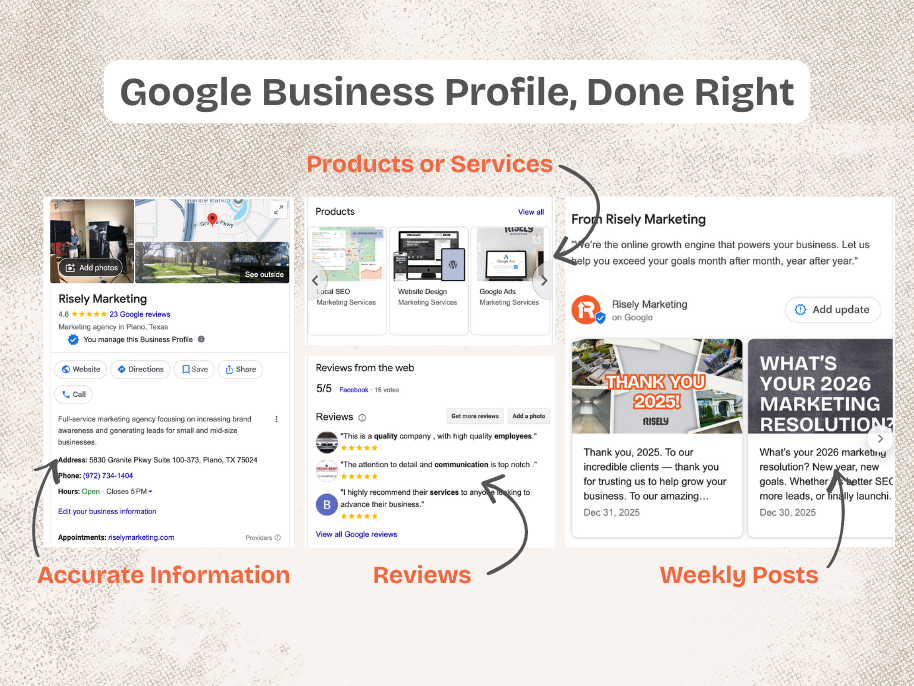
Treat your Google Business Profile like a living marketing channel.
- Post weekly updates or offers
- Fully optimize your services section with keyword-rich descriptions
- Upload fresh photos regularly, especially team and location photos
- Answer every review, good or bad
- Enable messaging and respond quickly
- Actively request reviews from real customers
Your service list should read like a menu that reinforces what you do and where you do it. This builds stronger local relevance signals for Google.
Pro tip: Linking YouTube videos, landing pages, and service pages inside your Google Business Profile increases engagement and authority signals.
2. Measuring Marketing Success by Lead Volume Alone
More leads don’t automatically mean better marketing.
One of the most damaging mistakes we see is businesses celebrating lead volume without asking whether those leads turn into revenue.
High lead numbers paired with:
- Low close rates
- High no-answer or no-show rates
- Poor-fit prospects
- Sales teams overwhelmed with junk leads
…is not success. It is noise that hides real performance problems.
This often happens when campaigns are optimized for cheap conversions instead of qualified demand.
What to do instead
Shift your focus from quantity to quality.
Start tracking metrics that actually impact revenue:
- Lead-to-close ratio
- Cost per acquisition, not just cost per lead
- Call answer rate for phone-based industries
- Lead source performance by revenue, not volume
Marketing should support sales, not flood it with unqualified inquiries. The goal is fewer wasted conversations and more closed deals.
If your sales team is constantly chasing bad leads, your marketing strategy needs correction, not more budget.
3. Relying Too Heavily on One Marketing Channel
If one platform drives most of your leads, you are exposed.
Many businesses go all-in on whatever is working at the moment. Google Ads. SEO. Meta ads. Retargeting. It feels efficient until something changes.
And things always change.
- Google’s AI-driven search results are increasing zero-click searches
- Paid ad costs fluctuate unpredictably
- Algorithms shift with little warning
- Platforms can throttle reach overnight
When one channel accounts for most of your traffic, a single update can cut leads instantly.
What to do instead
Build a balanced marketing ecosystem.
A resilient strategy includes multiple traffic sources:
- Search: Organic SEO and Google Business Profile optimization
- Paid: Google Ads and Meta campaigns with clear revenue tracking
- Owned: Your website, email list, and first-party data
- Social: Organic content with local and regional relevance
Each channel should support the others. Your website captures demand. SEO builds long-term visibility. Paid fills gaps and scales results. Social reinforces trust and brand recognition.
The goal is not to chase trends. It is to build a system that continues generating leads even when platforms change.
Why Fixing These Marketing Mistakes Matters Now
Small inefficiencies compound fast.
An outdated Google Business Profile costs you local visibility every day. Low-quality leads waste ad spend and sales time. Overreliance on one channel creates risk you cannot control.
Fixing these issues now puts you ahead of competitors who are still chasing surface-level tactics.
At Risely, we help businesses build marketing systems designed for sustainable growth, not short-term spikes. The companies that win in 2026 will be the ones that adapt early, track what actually matters, and stop repeating costly habits.
If your marketing feels busy but results feel flat, it may be time to leave these habits behind.
Request a free audit today!